That’s right! I’ve got a new location on the interwebs.
I’ll keep it brief and cut to the chase. But before I share the link, I do want to take a moment to say thank you if you’re reading this.
When I started this blog as part of a college project back in 2019, I didn’t expect to enjoy it so much that I’d choose to keep writing about marketing and PR for fun. As a self-diagnosed perfectionist, blogging used to be a long, drawn-out, painful process for me. It was almost like a chore.
The point about blogging that I was missing at the time is that it has to be first and foremost something you do for yourself.
But what about providing value? What about pleasing your audience? Isn’t that a little counterintuitive?
I thought so too at first. But once I started blogging about topics I really cared about in a way that was true to my personal experience, the writing became a labor of love rather than just labor. And as a blog reader, it’s way more exciting to read articles when the author’s passion and interest shine through. So thank you for reading and recognizing that passion in me.
Ultimately, I decided to move my blog to a different domain for a fresh start. I wanted to take my writing in a new direction: one that was even more aligned with my passions and interests than it had been previously. Using blogging as a way to keep learning about topics I love is something I hope to continue to do for the rest of my life. I would absolutely encourage anyone reading this to find their niche and do the same.
You can now find my blog under a new name, Harmonies & Hashtags, at https://www.meganfireland.com/blog. All of my old posts from WordPress will be archived, and I’ll be continuing to add new content related to the crossover between the music and communications industries.
It’s official. Broadway is back. And if you’re a musical theatre buff like me, I’m sure you’ve already been prepping to take pictures underneath the marquee, watch the curtain go up again for the first time, and all that jazz. 🙂
But believe it or not, not everyone has been so keen to return to the theatre. The health and safety threats of the COVID-19 pandemic are still keeping theatergoers at bay, especially older adults and individuals with preexisting health conditions. The boom in streaming services has also made it difficult for the live industry to compete and make a comeback. With comfort levels low, The Broadway League (the theatre industry’s national trade association) has been forced to innovate to get fans back to NYC’s Great White Way.
*Cue the “This is Broadway” campaign*
A $1.5 million industry-wide initiative, “This is Broadway” has been hyping up the return to live theatre in an unprecedented way. The campaign has spanned all types of media, from a short film honoring the Broadway community to a comprehensive website to a free in-person festival. But has the time, the effort, and the spending truly been worth it for an industry that already finds itself frequently having to cut costs?
Read on to find out as I break down the three main strategies behind the “This is Broadway” campaign and evaluate its success.
In an interview with the New York Times, Andrew Lazzaro, a marketing consultant for the Broadway League, said that their campaign strategy has been to target reliable theatergoers on the east coast. Through careful research, they have found that many of these Broadway regulars still need a boost of encouragement to resume their pre-pandemic habits.
The state of New York has focused recent marketing efforts on the larger goal of boosting tourism among travelers across the U.S. However, Lazzaro knows that getting the local, core Broadway audience to come back to shows needs to be made a priority before expanding advertising geographically.
This is likely why the “This is Broadway” campaign has included a number of local initiatives and events to ramp up excitement surrounding the return of live theatre. The Broadway League has sponsored multiple events around NYC in conjunction with the campaign, like a special lighting of the Empire State Building with members of the cast of Chicago and a free three-day theatre festival in Times Square called Curtain Up!. In addition, a giveaway sweepstakes will provide one lucky winner with four tickets to every Broadway show reopening over the next few months, driving awareness among east coast-based fans who have easy access to the city.
The campaign website also caters to theatergoers that can easily make it out to NYC for a day trip. The site functions as a “one-stop-shop” for all of Broadway, featuring real-time updates about returning shows, health and safety protocols, ticket information, and more. It even includes a show recommendation search engine, where interested theatergoers can choose a show or genre and get similar suggestions based on the industry’s past five years of audience data and ticket sales.
Strategy #2: Emphasize Community
The consistent emphasis on unity across all “This is Broadway” campaign materials has been impressive. In fact, the initiative is unique in Broadway history because individual shows normally handle their own marketing. However, it truly has taken the cooperation of everyone to bring Broadway back: actors and actresses, directors, crew members, agents, donors, audiences, and more. The League has been smart to honor this in their campaign messaging.
Watch the official “This is Broadway” video below.
The timing of Broadway’s return, which conveniently coincided with the annual Tony Awards on Sunday, September 19, also reinforced the unity of the theatre community. The Tonys are all about supporting one another in the theatre world and celebrating the year’s achievements. This year, the awards show also highlighted the resilience shown throughout the 18-month-long shutdown and recognized all the workers in the industry that are regaining their livelihoods with the reopening of Broadway.
This community-focused rhetoric expanded onto the “This is Broadway” website, social media copy, and display advertisements for the campaign in places like taxis, subway stations, and Times Square digital billboards. For example, The Broadway League’s Instagram post promoting the official video uses first person, community-oriented language, stating simply, “This is Broadway. We can’t wait to welcome you home!”
What’s more, everyone seems to be in on the excitement of Broadway’s big return, from major celebrities to media companies to government officials. News outlets like CNN, The New York Times, and NBC have prominently featured the campaign in their shows and articles. According to NYT reporter Michael Paulson, some media outlets have even offered The Broadway League discounted rates on campaign advertising placements. Major celebrities like Lin Manuel-Miranda and Idina Menzel have also taken to social media to promote Broadway’s return.
Strategy #3: Draw on Emotion Without Eliminating Health & Safety Rhetoric
“This is what we’ve all been missing. This is the romance and the rhythm, the triumphs and tradition. This is Broadway.”
The quote above from the home page of the “This is Broadway” website is an excellent example of this third strategy in action. While health and safety rhetoric is still a part of the language used on the site and in campaign promotional copy, it’s not front and center like in many other current arts, culture, and tourism campaigns.
Instead, focus is placed on the emotional aspects of live theatre: the joy the show experience brings and the triumph of what the industry has overcome over the past 18 months. Broadway is like a home away from home for so many, not just cast and crew members but theatergoers that crave the escape from reality that a live show provides. The League knows that in the end, missing that feeling is what is going to entice Broadway fans to return to live performances, even if they are hesitant to do so because of the ongoing world health crisis.
Emotional decision-making among potential Broadway audiences is further encouraged by social proof on the campaign website and social media, in the form of both testimonials and celebrity partnerships. Stories, memories, and inspirational quotes from both Broadway performers and beloved non-Broadway actors are featured in a scrolling visualizer on the site homepage, including Chita Rivera, Scarlett Johansson, and Hugh Jackman. Each individual show page also includes accolades and reviews from theatergoers and critics. This provides prospective buyers with complete information and entices them to get tickets.
My verdict on the “This is Broadway” campaign? A definite success.
Broadway’s ticket sales are climbing again and the campaign has garnered great engagement, both in the digital space and offline. Part of its success in enticing regular theatergoers to come back to Broadway has come from the careful attention paid to this target audience’s interests, needs, and wants. “This is Broadway” has also been successful because of the industry’s willingness to innovate and collaborate as a whole unit. Third, the Broadway League has used emotional rather than rational messaging to attract potential buyers. Emotional storytelling is at the core of what Broadway offers already, and it always wins over minds and hearts.
With Broadway only a few weeks into its reopening, it will be fascinating to see where the “This is Broadway” campaign takes New York’s live theatre scene in the coming months!
What do you think about The Broadway League’s big campaign? Would you have approached the return to live theatre with a different strategy? Be sure to let me know in the comments!
As a current graduate student, I’ve been conducting research projects for the past two decades of my life. I’m sure any other academic in their 20s can relate; we’ve practically been raised to run science experiments, think critically, and ask “why” since kindergarten. Research is all we’ve ever known.
Yet, not all research projects are created equal. There is a significant difference between quantitative, numerical research processes and qualitative, narrative-based ones. A statistical analysis will yield widely different results than a one-on-one interview. And it takes careful thought and consideration to determine the best method to use to answer a research question.
An ongoing debate exists between mass communications researchers about which approach is better. On one side of the argument are the positivists, who say that logic, objectivity, and empirical inquiry should serve as the basis of all research if it is to generate valid scientific knowledge. Alternatively, interpretivists maintain that an in-depth understanding of the meaning behind communication is the most valuable outcome of research, regardless of whether causality can be proven.
Below is a short video from Dr. Daniel Davis that examines the differences between the positivist and interpretive paradigms in the context of sociology.
Social Knowledge: Interpretivism vs Positivism – Daniel Davis [YouTube]
Both quantitative and qualitative research are valid approaches in the right context. Actually, in many instances, they have proven to be stronger when they work together.
To back up this point, let’s examine two different mass communications studies conducted in the past decade that investigated gender roles in the context of television advertising.
The first study, presented in a 2011 article in the International Journal of Advertising, measured gender stereotyping on public and private TV channels in Germany using quantitative content analysis. Five variables were chosen and coded to represent the concept of stereotyping in the ads analyzed: the main character’s age, credibility, location, product type, and role. Categories within each variable were assigned numerical values, and statistical tests were applied to prove that gender stereotyping still exists across many facets of television advertising (Knoll, Eisend, & Steinhagen, 2011).
The findings of the German study were conclusive and contributed significant knowledge to the field of communications. Through a quantitative method, evidence was provided that females in TV ads were portrayed more often as younger characters, product users, and in dependent or domestic settings. The study also uncovered a new part of the issue by highlighting differences between ads on private and public channels.
Despite the study’s strengths, it lacked a certain human element. Although it furthered our understanding of gender stereotypes in advertising, it failed to show why the research mattered and impacted real people. This is where qualitative methods come in.
The second study, taken from a 2020 issue of the Athens Journal of Mass Media and Communications, also used quantitative content analysis to investigate gender roles in TV advertisements (this time in Nigeria rather than Germany). However, this study’s quantitative research was supplemented by qualitative focus group data. Personal stories and opinions were gathered from a discussion with Nigerian schoolgirls about the advertisements, gender roles, and their personal values. In my opinion, the inclusion of the focus group data made all the difference in strengthening the study results.
Not only was the Nigerian study able to numerically show that gender stereotypes are present in advertising, it was able to place a face on the issue and show the real impact of such advertisements on young, female viewers. As the author notes, “data shows that advertisements portray women in the home as homemakers and people who do the shopping…” and “men as the gender that represents workplace, outdoor and leisure environments” (Anweh, 2020, p. 58). The reactions of the children who participated in the focus group confirmed that strong cultural value is placed on the female role as a caregiver in Nigeria.
Quantitative and qualitative methods are always better together. Numbers alone fail to represent the human impact of an issue under study. On the flip side, thoughts and opinions alone don’t always provide scientific credibility. But combine the two, and you’ll have a research project that’s robust, credible, and driven by deep human insight.
References:
Anweh, G. I. (2020). Gender roles representation in television advertisements: Implications for the Nigerian girl-child and role modeling. Athens Journal of Mass Media and Communications, 6(1), 43-64. https://doi.org/10.30958/ajmmc.6-1-3
Knoll, S., Eisend, M., & Steinhagen, J. (2011). Gender roles in advertising: Measuring and comparing gender stereotyping on public and private TV channels in Germany. International Journal of Advertising, 30(5), 867-888. https://doi.org/10.2501/IJA-30-5-867-888
If you were alive, you probably remember everybody rocking shoulder pads and listening to The Police. But it was also a significant year in the history of communication. 1983 marked the official birth of the Internet.
Granted, little did anyone know then what an integral part the Internet would play in our daily lives today.
Or did they?
One Canadian philosopher might have predicted the rise of the Internet decades before anyone else did, all the way back in 1962. And his name was Marshall McLuhan.
One of McLuhan’s central ideas was the concept of a “global village,” or a connected worldwide social and informational system that would form through the rise of electronic media. While this concept was met with vehement criticism in the ‘60s, it has seen a renewed interest in the past couple decades. With the age of the Internet, a global social order actually has come to fruition.
Still, a controversy among communication theorists remains. Did McLuhan really predict the Internet? Or was his theory of a global village merely coincidental?
A look at the philosopher’s other teachings may give us more of an answer.
In addition to the global village concept, Marshall McLuhan preached the idea of technological determinism, in which social organization is determined by the predominant communication medium in a culture at a given time. This was a particularly strong idea of McLuhan’s, as communication methods do indeed seem to play a role in social structures.
For instance, think about the rise of the telephone as a mode of communication. For the first time ever, people were able to talk to friends and family members from miles away in real-time. This drastically changed the way we related to our social connections.
Today, social media has again changed how we communicate with one another and structure our personal worlds. The ability to connect instantaneously with anyone in the world via text, audio, or video (and subsequently retrieve those messages at a later time) is remarkable. It has revolutionized social organization and allowed us to build vast networks of connections beyond the boundaries of geographical location.
Another aspect of McLuhan’s ideas that hits the mark is the way that he talks about communication in terms of environment and context. This is a big difference (and an improvement, in my opinion) from some of the psychological perspectives that were popular in McLuhan’s time. While theorists like Schramm and Osgood focused on the role of individual thought processes on communication, McLuhan asserted that media were the extensions of man. Therefore, he recognized how different media change the ways in which people take in sensory information, understand their environment, and relate to one another.
Check out the short video below for a deeper explanation of McLuhan’s “extensions of man” proposal.
Extensions of Man – Marshall McLuhan – Transition21 [YouTube]
While McLuhan contributed a lot to the field of communication study, not everyone was on board with what he had to say, especially in the ‘60s. Many of his ideas were at best confusing and at worst completely bogus. And this doesn’t help the case of proponents who believe that McLuhan truly did predict the Internet.
One major weakness of McLuhan’s hypotheses was his claim that “the medium is the message.” Essentially, this idea stated that the content of a message didn’t have any effect on its audience. The method by which the message was communicated was the only thing that mattered.
However, I can think of several instances where message substance does in fact matter. Perhaps the most obvious example is the job of any advertiser, branding expert, or content marketer, honing their message to have an effect on a particular audience. Many of McLuhan’s critics noted that to discount a message’s content was to ignore the entire purpose of communication.
Furthermore, the details behind some of McLuhan’s principles were not always clearly based in fact. Interestingly enough, McLuhan once said in an interview that “clear prose indicates the absence of thought” (Jacobs, 2011, para. 6).
To provide an example, let’s look at McLuhan’s 1964 report, Understanding Media: The Extensions of Man. One of its main themes was that media could be divided into “hot” and “cool” methods, which he explained in terms of the difference between a telephone and a radio. The radio, he claimed, was a hot medium, meaning it was well filled with data. On the other hand, the telephone was a cool medium because it offered the ear less information. If you ask me, anyone with an ounce of logic would say that this distinction is unscientific and makes no sense.
Third, McLuhan inadequately outlined the history of communication in terms of just three paradigms: tribal, print, and electronic. Some scholars consider these paradigms to be too simple and restrictive, as communication has been a part of life since humans came into existence. They argue that three communication eras can hardly do the entire history of humanity justice. There are at least transition times between the eras, like the slow shift from print-based news to radio and television news, that McLuhan should have taken into account.
When all is said and done, I personally don’t believe that Marshall McLuhan predicted the Internet; at least not in the way that we use it today. Too many of his ideas were flawed, based in opinion rather than fact, or failed to consider the importance of message content.
However, his idea of the global village does have merit in the sense that it accurately described the effects of globalization on social organization. And it did so before globalization took full shape.
Psychic or not, Marshall McLuhan’s ideas advanced the study of communication, particularly our understanding of the impact of electronic communication on social structure. But unfortunately, nobody realized just how much until 50 years after his time.
Imagine that you are the communications director for a large non-profit organization fighting for climate change awareness. Your boss is counting on you to come up with a breakthrough idea for the company’s next social media campaign. How do you persuade as many people as possible to take action? You have 60 seconds to come up with your message.
Ready, set, go!
Okay, have your idea?
If you’re anything like me when I was presented with a similar challenge back in college, you’re probably still sitting there dumbstruck, with no idea where to even start. (If by chance you did come up with a fully formed, realistic concept, please do spill your secret to success!)
Basically, persuasion is hard. It’s really difficult to know what people are thinking, how they will react in a given situation, and why they form certain attitudes. When you blow this up to the scale of mass media, your challenge multiplies tenfold.
Luckily, a theory exists to help make the job of persuasive communicators (like marketers, advertisers, and lobbyists) a little bit easier.
The elaboration likelihood model, or ELM, tells us that there are two main routes by which people may be persuaded: central and peripheral. When a message enters your brain, your understanding and acceptance of that message depends on your motivation, prior knowledge, and attitudes. If you view the message topic as personally relevant, interesting, or important, you will be more likely to process the information deeply using the central route. On the contrary, a person who is distracted or doesn’t care much about the issue being presented will process the information in a less active way, through the peripheral route.
We can actually be persuaded to take action as a result of both routes of processing. Cacioppo and Petty, the creators of ELM, believe that the types of information processing are not mutually exclusive, and “message receivers move along a continuum of probability to engage in effortful thought” (White, 2011, para. 1). Individuals who aren’t playing an active role in processing a message can still be persuaded to take action, as long as the message is tailored to their state of mind.
Check out the video below for a more detailed explanation of ELM from Michael Britt.
The Elaboration Likelihood Model Explained by Michael Britt [YouTube]
Now that you understand a little more about the elaboration likelihood model, let’s address the elephant in the room: How do you know whether your audience is going to process your message centrally or peripherally?
The short answer is that you can never really know for sure. But getting to know your audience through detailed research and persona formation can help you to make some pretty accurate educated guesses!
An amazing example of ELM at work in the real world is through celebrity endorsements. Steve Olenski says that when we see a high-profile figure appear in a commercial, it subliminally has an effect on our opinion of the brand they’re associating with, even if (and often especially if) we could care less about the brand’s product or cause. This effect may be positive, motivating us to buy the product through the peripheral route of persuasion. However, it may also be negative if we have a poor preconceived idea of the celebrity in question.
On the opposite end of the spectrum, the central route of persuasion is hard at play in political advertisements. While candidates do use emotion and music to reach peripheral processors, they also target audiences that care about the specific issues they are passionate about. They use rationally strong messages, statistics, and facts to rally supporters behind their social, economic, and/or political goals. According to the experts at MotionCue, this is the best way to drive strong and durable attitude change that is hard to convert down the road.
So, how do you use this knowledge to master the art of persuasion in your own messaging?
The bottom line is that you need to understand what your audience cares about. What are their current attitudes about the topic of your message? How about their prior knowledge level? To circle back to our original example with the climate change activist organization, you might consider conducting surveys with potential supporters to gauge their understanding of and passion for climate change issues. From there, you can use ELM to craft your message in a way that will meet your audience where they are.
Speaking to a group of newcomers to climate activism? Great. Hire a celebrity endorser and create a video that tells an emotional, compelling story.
Preaching to a group of seasoned sustainability officers? Then maybe consider presenting some hard data about why your organization is worth supporting more than others.
It takes practice, but when you do your research and apply the principles of the elaboration likelihood model, you’ll see that mastering the art of persuasion isn’t all that difficult after all.
Depending on your personal experiences, opinions, sources, and the day you read this post, each person will likely have a very different answer to this question.
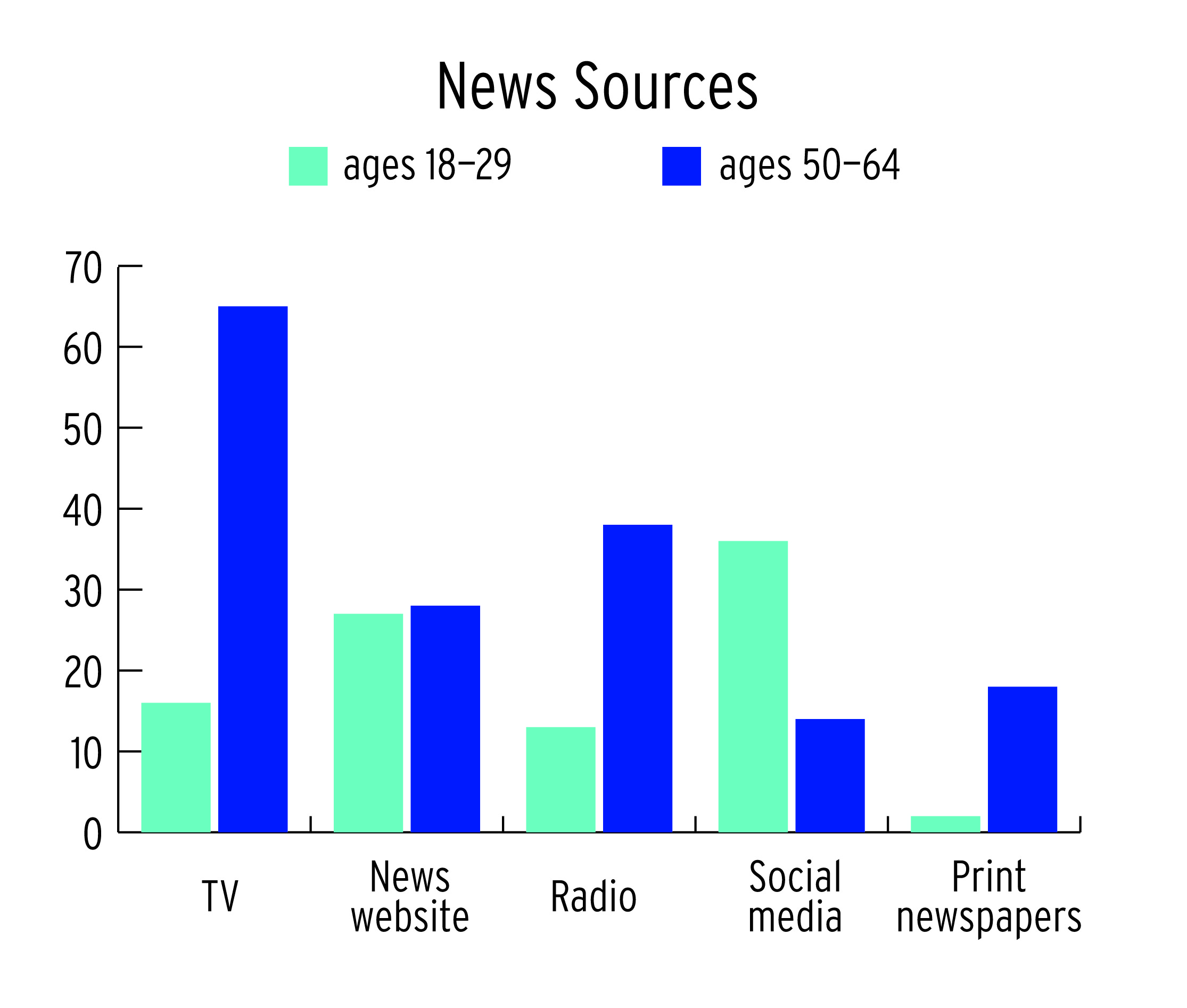
In today’s digital era, we tune in to news stories from all kinds of places, including television talk shows, online journals, physical newspapers, and social media. Like so many other young adults (almost 40% of 18-29-year-olds, according to the graphic below from BYU), social networks like Twitter and Facebook used to be my go-to when checking in on the latest world news. But believe it or not, learning about a simple communication theory from the 1940s caused me to change my habits.
The two-step flow model of communication, invented by Paul Lazarsfeld in 1948 but popularized by sociologist Elihu Katz in the late 1950s, teaches that media messages are passed through a select group of opinion leaders before reaching the public. In turn, says Gabriel Weimann, these opinion leaders hold a considerable amount of influence over the flow of information to the public.
According to the two-step flow theory, not only do opinion leaders control which news is given the most weight, they affect public opinion about that news too. The concept seems easy enough to understand, but when you throw today’s interactive media landscape in the mix, things get a little dicey.
Nowadays, different people trust and pay attention to different opinion leaders, thus greatly altering their perceptions of the day’s news stories. And this makes getting news from social media particularly dangerous.
Online, we have the ability to choose who we want to follow and who we don’t. If information is filtered through opinion leaders who share an individual’s viewpoints and opinions, news on social media has the potential to perpetuate echo chambers that merely affirm one’s own beliefs rather than educate. In a 2020 study, Elizabeth Dubois et. al. found that opinion avoiders, or individuals who refuse to play an active role in gathering news information, are especially at-risk of being trapped in these echo chambers and believing misinformation put out by opinion leaders.
The prevalence of news gathering on social media makes the perpetuation of echo chambers an even more pressing issue. According to the Pew Research Center, more Americans get news on social media than from print newspapers, with around 4 in 10 choosing to read their news on Facebook.
Essentially, what Solis is getting at is the fact that our behavior on social media is governed by both emotion and the actions of others.
We might like to think that we choose our news sources in a perfectly rational manner. However, our inherent need to belong has a large, subconscious impact on our information seeking habits online. As a result, we are automatically more likely to hear, believe, and share news from opinion leaders who are like us, reinforcing our social connections but not necessarily the facts.
Wondering what to do with your newfound information about the two-step flow theory? Not to worry.
While I wouldn’t necessarily advise against news gathering on social media altogether, I do think it’s important to know how opinion leaders can affect us online. I believe that it is only with a solid understanding of the two-step flow theory and the psychology behind social networks that we can safely gather news on the Internet. Luckily, by reading this post, you’ve already taken the first step towards a better news gathering process!
The bullet theory: Sounds a little menacing, right?
In many ways, it is. This theory of mass communication, developed mainly by Harold Lasswell in the 1920s and 1930s, centers around the idea that the media “shoot” messages into the minds of the public. These messages, according to Shraddha Bajracharya, are said to have a strong, immediate, and uniform effect on the audience, making them powerful and even dangerous.
The thought of the media controlling our brains with propaganda coupled with the imagery of a “media gun” is admittedly creepy. But at the same time, we know so much more about how communication works today than we did when the bullet theory was invented. As it turns out, mass communication is a much more complex process than Lasswell envisioned. The rise of social media over the past 15 years has made this especially true.
So how much control do the mass messages we see on TV, news sites, and social networks really have over our brains? The truth is, probably more than you think.
It may be a little extreme to say that we passively accept every message we see on the news. However, the wealth of digital data available to media companies has certainly made it possible to selectively send messages to the people most likely to pay attention.
This already occurs quite frequently in media advertising, where companies only pay to market products and services to their ideal customers. HubSpot’s Steve Bonnell says that with data, we actually have the capability to customize online content down to the individual user.
While selectively sending news-related messages to individuals might seem unethical, it too already happens to a certain degree. It isn’t the sadistic minds of media executives that causes this to happen, but the freedom of information that people have been given in the digital age.
Seem a little backwards? If you think so, I have to agree. Yet, studies have consistently shown that the more information made available to us, the more selective we are in seeking out content that affirms our beliefs and attitudes.
In a widely shared MIT Technology Review article from 2018, Zeynep Tufecki elaborates on this idea. She says that, though we do tend to encounter a diverse range of opinions online, the social nature of the Internet causes us to share and comment only on those that our like-minded peers will approve of. As she (quite brilliantly) puts it, “belonging is stronger than facts” (para. 39).
Not convinced of the polarizing power of the media yet? Take a look at the PBS NewsHour segment from 2017 below.
How politically polarized media is driving our alternate realities – PBS NewsHour [YouTube]
To connect all of this back to the bullet theory of mass communication, I think it’s reasonable to say that Lasswell’s fears of media-led “brainwashing” aren’t completely bogus. No, I don’t believe that mass media companies (or even influential figures on social media) control every way that we think and behave. Nor do I believe they are trying to do so. But it’s impossible to ignore the interplay between targeted media messaging and the social polarization that has become so prevalent online.
In this digital age, not only are we served messages that affirm our personal values more often, but we’re more likely to spread the word about them too. And, like the bullet theory, that has a strong, immediate, and potentially dangerous effect on society.
What are your thoughts about the bullet theory in a modern-day context? Does it still hold any legitimacy, or is it a thing of the past? Be sure to let me know in the comments!
To the average person, I, IV and V are hours of the day. But to the trained musician, they are a set of instructions. They tell the performer to play chords, and are an integral part of the way the musical system works.
There are a lot of bloggers out there that debate whether or not it’s important to learn music theory – the study of this musical system – as an artist. Adversaries argue that many theory concepts are too complex to be worth taking the time to learn. And true, you don’t have to know that I, IV, and V are chords, adagio means slow, and a rondo is a song structure to play music.
Still, my experiences as a college music major have shown me just how useful music theory knowledge can be, even for mere music listeners. Of course, the amount of time necessary to dedicate to learning music theory depends on your experience and how you intend to use that music theory knowledge. But I believe that it is worth at least getting your feet wet with the basics. Not only can music theory help you to read, understand, and play pieces more efficiently, it can help you to enjoy all music on a deeper, more meaningful level.
So why learn the rules at all if we’re just going to break them in the end? I know I asked myself this question countless times as a freshman in college as I tried to wrap my head around the circle of fifths. The simple answer is this: “Creativity requires direction or it’s just chaos” (Ledger Note, para. 23). Your music will just not feel right unless you have a basic knowledge of how rhythm, chords, key signatures, and other critical principles work. Even bands that have rewritten the rules – The Beatles, Queen, and Bob Dylan, to name a few – have styles that are rooted in music theory. Because frankly, when the music doesn’t make sense to our ears, its meaning is lost in translation.
The claim that complex, classical music theory concepts aren’t worth learning is definitely the most legitimate one on the table. Even several music majors like Ethan Hein believe that these rules are irrelevant knowledge for success in the present-day musical world. While I agree with them to an extent, the necessity of studying the nitty gritty details of music theory depends on what you intend to use the knowledge for. Just as the pioneering bands I mentioned above based their music in the rules of theory, so too are many popular genres rooted in classical forms and chord progressions. In fact, in an article entitled “What pop music owes to the classical masters,” Guardian editor Imogen Tilden writes:
The likes of Gluck, Mozart and Haydn created a whole new style based on, essentially, four major chords. Much of their music is based on the tonic [I], dominant [IV] and subdominant [V] – just like much of rock’n’roll. (para. 1)
– Imogen Tilden
If you’re just curious and want a deeper understanding of the music you listen to, you may find yourself in over your head if you start analyzing the complexities of Beethoven and Mozart. But I believe that it truly is important for aspiring performers or teachers to know exactly where modern popular music came from. If anything, learning the theory behind classical music (some of the most complex and ingenious music to exist, in my opinion!) can help artists more quickly and easily pick up on patterns in the music they play, freeing up time and brain power for creative expression.
Music is constantly evolving and changing, and yet its foundations have remained the same for centuries. And you can’t build a house without a foundation, just like you can’t really create a piece of music that people will resonate with unless you have an understanding of musical structure. So whether you are an aspiring composer, performer, or just a music lover, exploring a bit of music theory is definitely worth your time!
They probably seem like they were pulled out of a science fiction movie, a gadget of the future. But not only are bone conduction headphones real, they’re accessible to the average person, no more expensive than a pair of regular old AirPods.
Resting on the cheekbones rather than going in or over the ear, bone conduction headphones transmit sound vibrations through the bones in your head instead of through the air to your eardrum. This method of hearing allows the vibrations to bypass the auditory canal and go straight to the cochlea, the fluid-filled chamber where the brain processes sound. However, there is considerable debate over whether the sound quality of these headphones is on par with that of regular earbuds. In fact, writer Ben Kuchera of Ars Technica and others claim that they have a tinny, distorted quality that may make them not worth the money.
I don’t pretend to be an expert on bone conduction headphones – to tell the truth, I’ve never even owned a pair. But being a bit of an audio junkie, I had to find out all I could secondhand about the science of bone conduction. And through my research, I’ve compiled a subjective list of the five most important things to know before you consider buying a pair of bone conduction headphones.
1) Bone conduction is not a new science.
Knowledge of bone conduction hearing has actually been around since the 1500s, and bone conduction headphones have been used for improved communication in the military for over a decade now. They don’t seem to be revolutionizing the way we listen to music either, although they may provide new opportunities for people with hearing damage. Because the sound vibrations detected via the bone conduction method don’t pass through the outer and middle ear, it provides a better listening experience for individuals with a damaged eardrum. Bone conduction technology is used in many hearing aid systems for this very reason.
2) If noise cancellation is important to you, don’t buy them!
Bone conduction headphones are designed to allow the listener to be more attune to their environment. They’re definitely not meant for quiet study sessions, but if you’re looking specifically for a pair of bluetooth headphones for running, biking, or another athletic activity, then they might just be a match. Athletes often need to be aware of their surroundings but don’t want to sacrifice good tunes, and bone conduction headphones can give them the best of both worlds. In addition, their unique shape and positioning on the skull help them to fit underneath most helmets, unlike regular earbuds. But despite the pros for athletes, bone conduction headphones don’t seem to be the best option for any other activity. Even with earplugs, they are about as far from noise-cancelling as you can get.
3) Their audio quality is definitely sub-par
Enough articles have been written bashing the sound quality of bone conduction headphones to convince me that they’re not going to sound like Bose. Daniel Varghese of GQ Magazine labels them as “horrendous for day to day use” and “totally unintelligible at anything other than extremely loud volumes” (para. 7). The bass tends to get lost in translation traveling through the bones, and mid-frequencies can be muddied as well. Still, many users – especially athletes – have said that the deficiencies in quality aren’t as bad as people make them out to be. In his YouTube video about bone conduction, Dr. Cliff Olsen remarks that the audio quality of a pair of these headphones is just as good as a pair of low-grade earbuds. But even if this is the case, cheap earbuds certainly doesn’t equal great sound.
4) They may be less likely to damage your hearing
Because bone conduction headphones don’t stimulate the eardrum, there is a possibility that they are less likely to damage your hearing. But the keyword there is possibility. Turning up the volume too loud on any pair of headphones can be harmful to the cochlea, and bone conduction headphones are no exception. Additionally, Dr. Cory Portnuff of the University of Colorado states that “bone-conducted sound is transduced by the cochlea similarly to air-conducted sound” (para. 4). Because bone conduction headphones are poorer noise isolators than regular earbuds, they could actually pose an even greater risk to users who don’t realize how high they are turning up the volume to combat ambient sound. So although in theory it seems like bone conduction headphones should be less likely to damage your hearing (given that they are used properly), further research remains to be done.
5) They might take a little bit (or a lot) of getting adjusted to!
Bone conduction headphones have to apply a little bit of pressure in order to vibrate the bones in the skull and work properly. For certain head shapes, this can make listening uncomfortable – and at the very least, it will take anyone a moment to get used to hearing music through their bones versus through their ear canal. Though some people may experience more discomfort than others, it seems to be worth trying on a pair before you buy.
So there you have it: my humble opinion on the topic of bone conduction headphones. This short list may make it seem like the cons of using them far outweigh the pros. But don’t be discouraged. If you know what you’re getting into and you have a purpose for buying them, bone conduction headphones definitely have the potential to be a worthwhile investment.
If you’re tuned in to entertainment and pop culture, chances are that Nashville, Tennessee is towards the top of your list of places to visit – even if you’ve already been 20 times!
Dubbed “Music City USA” for over a century, Nashville is known for its vibrant culture and quality of musical talent that has consistently kept people (musicians and non-musicians alike) coming back for more. It is deservingly ranked as having one of the best music scenes in America by places like CNBC, Forbes, and Travel and Leisure Magazine. And it’s up there with cities like New Orleans, Austin, and New York. But why Nashville?
Situated in the center of the country, rolling plains and cornfields are often the first thing people picture when they think about Middle Tennessee. And that image is not entirely wrong. The Nashville area sits down in the Central Basin, a large, low, and flat area well-suited to farming. But the city’s geographic location is actually one of the things that helped it to grow into the bustling music hub it is today.
Settlers in the 1700s were drawn to the area’s fertile soil, and quickly realized that the Cumberland River also made it an excellent location for trade. They established a community on the river shores and brought with them the traditional English fiddle music they used to play back home. As the population continued to grow, so did the music, with more and more cultures and styles coexisting and blending together. This melding of cultures eventually led to the creation of the Fisk Jubilee Singers, an African American a cappella group from Nashville’s Fisk University, who would go on to play a pivotal role in the making of “Music City USA.”
As the legend goes, Queen Victoria of England heard the singers on a tour of Europe in the 1870s. She was so delighted with their performance that she exclaimed that they must have come from the “city of music.” Although this story has never been proven true, the Fisk Jubilee Singers certainly did set a precedence for the quality of music produced in Nashville. They also broke down racial barriers after the Civil War, garnering national attention when they were invited to sing at the White House by President Ulysses S. Grant.
While Nashville’s rich musical history is an important part of how it came to be known as “Music City USA,” it doesn’t really explain why music lovers continue to choose it over New York, Los Angeles, or some of the other arts-oriented cities in America. Sure, Nashville may be home to the famous Grand Ole Opry and the Country Music Hall of Fame, but what does its music have to offer that is different?
Author Jim Russell perhaps best explains the Nashville phenomenon by saying that here, unlike many other big cities, “quality of interaction trumps density of interaction” (para. 8). By this, Russell means that the sheer amount of talent within the confines of Nashville is enough to blow any other city away, even if its population is five times as large. Quality of music over quantity of music.
This force of talent is especially attractive to young musicians looking to break into the business and make connections. Nearly every major record company in the game, from Sony to Universal, has offices in Nashville. In addition, there are dozens upon dozens of smaller indie labels scattered throughout the city, not to mention talent agencies, publishing companies, music schools, and more. Nashville blogger David Hooper attests that “the level of musicianship is so high that you can walk into the worst place in town and see somebody good” (para. 4).
Also attractive for aspiring musicians is Nashville’s affordability in comparison to other big cities across the U.S. As appealing as New York City and L.A. may be, the cost of living on the east and west coasts is a huge financial hoop to jump through for starving artists. However, Nashville – being centrally located – has both a lower cost of living and a more convenient location for audience members looking to visit. Margaret Littman of Next City news organization mentions that you can actually “reach at least half of the country’s population within a one-day’s drive of Nashville, making it an ideal place to start a tour or ship records from” (para. 16).
Ultimately, Nashville’s combination of rich musical history, geographic location, cost of living, and mass of talent make it the perfect place for both music players and music lovers to settle. While any major U.S. city may have these factors, it is the unique way that they have interacted to build an artistically-driven culture that truly makes Nashville deserving of the title “Music City USA.”
People, quite simply, are drawn to good music. And Nashville’s established standard of quality entertainment makes it a captivating destination not just for musicians, but for all.











 Megan Ireland


